

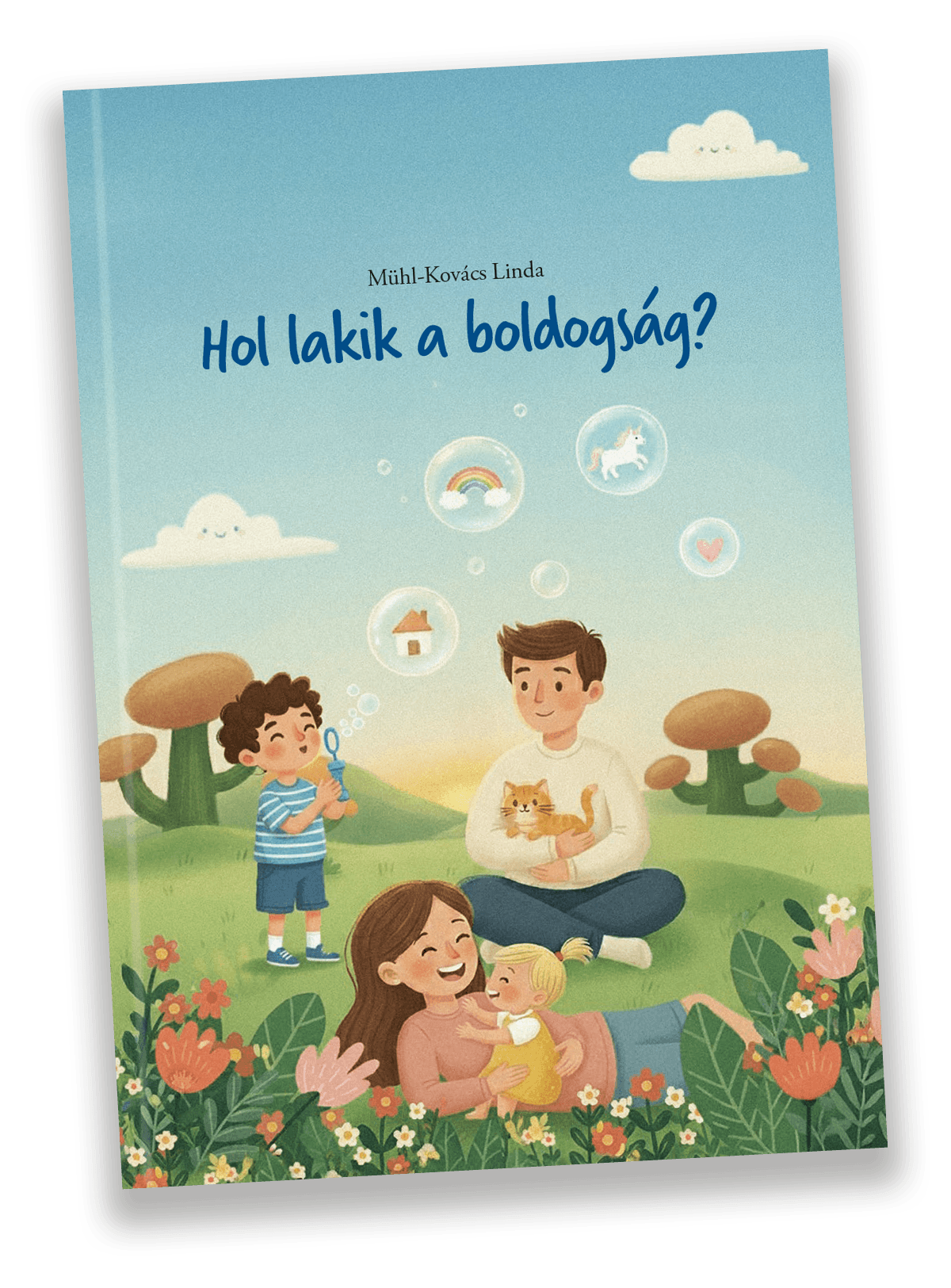
Where does happiness live?
Linda Mühl-Kovács
Happiness is not a matter of luck but a learnable way of functioning. The book guides you through the 7 key areas of the happiness rainbow with small, everyday practices: responsibility, awareness, mental and physical health, lovingness, purpose, environment.
Order nowHappiness is not a pink haze, it's experiencing reality well.
This book shows that happiness is a way of functioning that can be learned from childhood. It doesn't dictate rules, it lays out: this works too. Because there is no perfect parenthood, only real, personal paths on which connection gives safety.
First you. Then the two of you, together.
Part 1 – For you.
Strengthens your own inner balance, presence and harmony: a 21-day programme + 2 key practices you can use anytime (breathing, meditation).
Part 2 – For you both.
Then the two of you set out to explore together. Through stories and play the child (ages 2–6) learns to regulate emotion, and gains safety and confidence: 9 “lifebuoy” exercises + a 12-day shared programme.
What does the book give you?
Together, not separately.
First it strengthens you, then connects you with your child through shared, playful exercises.
Small steps, without guilt.
Every exercise has a minimum version; as much as you can manage is enough.
Not a parenting tip – a shared skill.
The child learns through story and play; the two of you grow together.
A tangible framework.
7 areas, a 21-day on-ramp, repeatable afterwards. The measure is always “a snapshot, not a diagnosis”.
Who is this book for?
- Parents raising a child aged 2–6.
- Those who seek not more time but better-quality presence.
- Those who think in permissive, small steps instead of guilt.
- Those who want to grow together with their child, through shared experiences.
What others say about it
A special book that speaks to parents and children at once, helping them discover the secrets of happiness in a playful way. The book doesn't just convey theoretical knowledge but helps parents develop their children's emotional intelligence while they themselves set out toward a happier life.
In my view the reader holds a much-needed book. Beyond containing theoretical knowledge, its practical “guide” is unique. I recommend it to every parent who wishes to experience balanced, harmonious time together, and to give the child positive provisions that benefit them into adulthood. I hope every mindful parent who wants to raise their child toward happiness recognises the book's value and applies what it suggests!
Choose a bundle
Printed book
The hardcover edition of “Where does happiness live?”, shipped by us.
HUF 6,390
Order nowCompass to Happiness (PDF)
Instant downloadA downloadable 5+5-day sample programme for you and your child – not the same content as the book. Available for download immediately after payment.
HUF 1,990– no shipping
Order now
Frequently asked questions about the book
What is the book “Where does happiness live?” about?
A practical book for parents and children aged 2–6 about more balanced, happier everyday life. It has two parts: the first strengthens the parent's own balance, the second connects with the child through shared, playful exercises.
Is this a parenting book?
Not a classic collection of tips. Rather, it shows what happiness is, what it's made of, and how it can become part of everyday life – first for the parent, then together with the child.
How is this book different from other parenting or self-help books?
It speaks to parent and child alike: instead of separating family members, it creates a shared, joyful ritual where both of you recharge equally. It genuinely fits into a day (10–20 minutes): it doesn't demand extra hours from your crowded calendar, it works with tiny micro-practices. And it is a practical guide, not theory: instead of dry professional text it hands you tools you can try right away, proven in practice.
Is the book strictly for ages 2–6?
Part 2 of the book (the stories and games) is tailored to the developmental needs of 2–6-year-olds. At the same time, Part 1 (the parent's inner balance) and the 7-area rainbow approach are a huge help for the parent of a child of any age. The children's part can also be stretched to ages 7–8.
Is 10–20 minutes a day really enough? Our days are very full.
Yes, and then some! Every practice also has a “minimum version” of just a few minutes. The goal isn't to squeeze another programme into the calendar, but to fill the evening or daytime minutes you already have with real presence.
What if I have more than one child (say a 3- and a 5-year-old)?
The stories and playful practices work wonderfully with several children at once; in fact they also strengthen the sibling bond and the shared experience.
What should I do if my child just isn't in the mood?
We never force it. The method builds on the parent's example and on playfulness. If you start the practice or the story, your child will join in out of curiosity. If not today, then tomorrow or next week, just don't give up. Consistency and the parent's example matter.
What if I don't want to work on myself right now, I'm only looking for something for my child?
You don't have to “work on yourself” in the classic sense: Part 1 isn't about burdensome tasks but about 10-minute, instantly calming micro-rituals (a single conscious breath, or a pause in the middle of the day). You can also skip straight to the shared part: the book's structure is flexible, and if right now you only have capacity for the stories, the games and calming your child, you can dive straight into the shared experiences and the “lifebuoy” exercises. And playing with your child recharges you too: the parent's own recharge often happens unnoticed during shared storytelling and play – it doesn't take extra energy, it makes the minutes you already share lighter and more joyful for both of you.
Do I need the app alongside the book?
The book is a complete experience on its own. The app is a convenient digital support (for tracking progress and the rainbow wheel, for example), but it isn't required for doing the practices.
How does the author know this really works?
Linda Mühl-Kovács is a communications professional, wellbeing ambassador, trained yoga, children's yoga and meditation teacher and, most importantly, a mother. The methodology wasn't born behind a desk but in the everyday life of her own family (and those around her). Linda combined her own parenting experience with recognised research foundations (the theories of Diener, Seligman, Csíkszentmihályi and the Blue Zones). Her credo: happiness is a consciously learnable way of functioning, acquired most effectively in shared parent-child connection.
Where can I order it?
Directly on the happinest.club site, for 6390 HUF.